



Look, I’ve been posting on Substack for the past 5 months or so and I’ve seen really good writers with incredible style, great post hooks, valuable content. The best ones really deliver on what they promise.
But one thing kept me turned off about some of them. This might be something very subjective to me, but I kept seeing specific patterns coming up in everyone’s writing. Those are the very well-known AI patterns such as the mirror pattern “it’s X not Y” or the rule of 3, etc. All of us have seen those 3,000 times across all social media platforms.
I’ve spotted so many of them myself that I cannot unsee them now.
I’m not even against the pattern itself but for me it’s about everyone sounding like every other writer. There’s no way that I can say: “Oh, this was written by Tim and this written by Hannah.”
The 99% of people out there create content with AI. Are they dumb? No, of course not. Look, I use AI for writing too, but I’d never say “Write me a post about XYZ” and publish it. Nobody’s gonna read it because it still sounds generic, vague and more importantly “not you”.
I don’t want to sound AI, but I want to use AI because it’s a powerful piece of tech that boosts everyone’s productivity and gives you more room for expressing your creativity.
What I use it for is grammar, stylistic adjustments and basic drafts starting from an idea. The idea and the structure still come from my side, while the boring editing and checking is on my AI assistant’s shoulders.
So here’s what you’ll have by the end of this article: a setup that reads any draft you give it, finds every AI pattern sitting in it, and rewrites them out in your own voice, measured from your own old writing.
3 steps, about 35 minutes, and you only do it once. After that it’s one sentence, “de-AI this”, plus the draft.
First though, why the usual word lists don’t catch it, and then the patterns themselves, because you’re the one approving whatever comes back.
Subscribe to No BS AI
One real copy-pasteable build like this every week.
The word list is real and it already stopped working
Look, you can go to the web and search for how to make your writing sound less like AI and you’ll get a list of words like delve, leverage, seamless, robust, tapestry, someone will suggest to kill the em dashes as well.
That list is unfortunately real, and there’s proper research under it. A team read 15 million biomedical abstracts on PubMed and watched the frequency of those style words jump the moment ChatGPT arrived. Their estimate is that at least 13.5% of 2024 abstracts had an LLM in the loop, and in some journals it reaches 40%. That’s a peer reviewed paper in Science Advances.
So those words are a real signal plus they’re the cheapest thing to fix.
I’m gonna be honest with you. I deleted every one of those words out of my drafts months ago and the drafts still read as AI to me.
Then I found the study that made me throw the word list away completely because I realized that non-native English writers were more prone to be flagged by GPTs than native ones.
In 2023 a Stanford group ran 7 popular AI detectors over 91 TOEFL essays, all written by real humans, all of them non-native English speakers. The detectors called 61.3% of those essays AI-generated, and at least one detector flagged 97.8% of them. It’s in Patterns if you want to read it.
Ok. Enough about the boring stuff.
One more thing worth keeping in mind: the model always averages your draft toward the middle of everything it has ever read, and the middle has no accent, no style. A Cornell team measured that at CHI 2025. With an AI writing assistant switched on, essays by Indian and American writers became measurably more similar to each other, and a classifier trained to tell the two groups apart fell from 90.6% accuracy down to 83.5%. The difference in vocabulary range between the two groups disappeared completely.
So I’d say what people call sounding AI is mostly your own writing getting averaged over the whole web that it’s been trained on.
The 12 patterns
I made some research and this is what people call “AI patterns”.
The compressed fragment. A short sentence that sounds like a verdict. “Which is not 10 minutes.” I believe it’s the most common one of all, because it’s exactly what you get when you ask an AI to make writing punchier.
The symmetric reversal. “It’s not a tool problem, it’s a process problem.”
The negated setup. “The instructions were never the problem. The description was.” The first sentence carries nothing and exists to stage a reveal.
The reveal tease. “Here’s what nobody tells you.” The fact is always more interesting than the promise of the fact.
The false consensus. “Most people get this wrong.” You don’t know what most people do, and your reader knows you don’t.
The counted claim with nothing to count. “3 things are going wrong here”, then 3 paragraphs of wall text.
The rule of 3. 3 examples where you only have 2.
The maxim in a box. Your own line lifted out of its paragraph and set apart as a blockquote. Inside the paragraph it’s an observation, in the box it becomes a slogan.
The moral tail. A fact, then a sentence explaining what the reader should take from it.
The floating claim. An opinion with nobody attached to it. This is the quietest of the 12 and I’d say it’s the worst, since nothing in the sentence is wrong, there’s just no person in it.
Wrong wording. “Genuinely miserable” where “genuinely horrible” is what you’d actually say in a real convo.
The stacked ending. A moral, then an instruction, then a callback, then a sign-off. Each one is fine on its own and 4 of them in a row is a performance.
You can write a paragraph with zero banned vocabulary, zero em dashes, and still hit 6 of the 12 inside 4 sentences.
The 2 minute version
If you want something right now, before any setup at all, take this:
Open a Claude Project
Paste this into the instructions box:
## NEVER USE THESE PATTERNS IN MY WRITING
1. **The compressed fragment.** A short sentence that sounds like a verdict. "Which is not 10 minutes." I believe it's the most common one of all, because it's exactly what you get when you ask an AI to make writing punchier.
2. **The symmetric reversal.** "It's not a tool problem, it's a process problem."
3. **The negated setup.** "The instructions were never the problem. The description was." The first sentence carries nothing and exists to stage a reveal.
4. **The reveal tease.** "Here's what nobody tells you." The fact is always more interesting than the promise of the fact.
5. **The false consensus.** "Most people get this wrong." You don't know what most people do, and your reader knows you don't.
6. **The counted claim with nothing to count.** "3 things are going wrong here", then 3 paragraphs of prose. You promised a shape and handed over a wall.
7. **The rule of 3.** Three examples where you only have two.
8. **The maxim in a box.** Your own line lifted out of its paragraph and set apart as a blockquote. Inside the paragraph it's an observation, in the box it's a slogan.
9. **The moral tail.** A fact, then a sentence explaining what the reader should take from it.
10. **The floating claim.** An opinion with nobody attached to it. This is the quietest of the 12 and I'd say it's the worst, since nothing in the sentence is wrong, there's just no person in it.
11. **Wrong wording.** "Genuinely miserable" where "genuinely horrible" is what you'd actually say in a real convo.
12. **The stacked ending.** A moral, then an instruction, then a callback, then a sign-off. Each one is fine on its own and 4 of them in a row is a performance.
You can try this technique of course, and it’ll work about 1 in 3 times, just because AI models are non-deterministic and they slightly change their output every time you ask them.
Making it fully deterministic is impossible. What you can do is push the probability of a good output high enough that you stop rewriting everything by hand, and 3 things do that: giving the model your actual voice to copy, making it check every sentence one by one, and telling it which patterns get fixed by deleting and which by adding.
That’s what the next 35 minutes buy you.
The setup: 3 steps, about 35 minutes, once
Everything below chains, and that’s what makes it hold. Step 1 gets your writing samples. Step 2 turns those samples into a file called my-voice.md, which is your own fingerprint written down as numbers. Step 3 installs a skill that reads that file every single time it touches a draft.
Step 1: find 3 to 5 things you wrote before AI (15 minutes, longer if you have to go digging)
One obvious way of making AI sound more like you is to give it examples of what you’d like to replicate.
That’s why I recommend going and digging out 3 to 5 pieces of writing you produced before you started running things through a model. Something like old articles, blog posts you have written, or old emails, Slack messages, a WhatsApp thread might work. All that matters is that you wrote it and no model ever touched it.
Two things help here. Pick pieces where you were writing to one person, because writing to an audience is already a bit performed, and pick the ones you’d be slightly embarrassed by, because the typos and the odd phrasings are exactly what we’re about to measure.
Put them all into one document or one folder and you’re good.
Step 1 done.
Step 2: turn them into your voice fingerprint (10 minutes)
Now you measure them. Paste this into Claude together with everything you dug out in step 1:
## Your job
Read the pieces of my own writing below and measure my voice as numbers.
Measure only what is actually in front of you. Never guess, and never tell
me what good writing looks like.

Give me these 6 things:

1. My average sentence length in words, then my longest and my shortest.
2. What share of my sentences open on a connector (And, So, But, Now, Which).
3. The filler words I actually use, quoted exactly, with a count for each.
   Things like honestly, actually, of course, just, really, look, I mean.
4. Which contractions I use, and the places where I expand them instead.
5. Every grammar slip or odd construction that turns up more than once,
   quoted verbatim. These are my fingerprint. Do not correct a single one
   of them, just list them back to me.
6. How I close. Copy out the last 2 sentences of each piece.

Then write all 6 into a file called my-voice.md, in that order, and give me
the whole file back.

## My writing
[paste your pieces here]
What comes back looks something like “average 19 words a sentence, 22% of your sentences open on a connector, you write honestly 11 times and of course 7 times, and you write I work with this client since March where the textbook wants I have been working”.
I nearly deleted that fifth category the first time, because it reads like an error list. Keep it. Those slips are what makes your writing hard to copy, and smoothing them out is how a draft ends up sounding like everybody else.
Save what comes back as my-voice.md. Step 3 reads that file.
Step 2 done.
Quick note before Step 3. That prompt measures what your old writing already does, and those 6 measurements are enough to run everything below.
What it can’t catch is a preference your old writing never had to show.
So I built Soundcheck, which is a guided session that hands you 4 versions of the same sentence and asks which one is yours, round after round, and it ends with a finished voice.md: your style calibrated exactly to your style, it captures even the smallest details (did you use “honestly”/”like” or other hedge words in the sentence and more), the DOs and DONTs of your writing.
If you go that way, rename the file it gives you to my-voice.md and drop it into the same folder in step 3. The skill reads it either way.
Completely optional though, the free 6 will just get you 50% of the way there.
Step 3: install the de-ai skill and run it on a real draft (10 minutes)
This is the file that does the actual work. Copy it, save it as SKILL.md in a folder called de-ai, drop your my-voice.md from step 2 into that same folder, and put the folder into Claude’s skills panel. If you’ve never made a skill before, a skill is a folder with one text file in it, that’s all it is.
This is the whole prompt:
---
name: de-ai
description: >-
  Finds the 12 patterns that make writing read as AI-written and rewrites them
  out, in the author's own voice, learned from the author's own older writing
  instead of from a style guide. Use when the user says "make this sound like
  me", "this sounds like AI", "de-AI this", "remove the AI patterns", "rewrite
  in my voice", "check this before I publish", or pastes a draft and asks
  whether it reads as AI. Also use before publishing any article, newsletter,
  post or email that an AI helped write.
---

# de-ai

Two jobs. Find the patterns that make writing read as machine-written, then put
the author back in.

Never run job 2 without job 1, and never run job 1 without a voice sample. A
rewrite with no sample just swaps one default voice for another default voice.

If a file called `my-voice.md` sits next to this one, read it before anything
else. It wins over everything below, because it is a record of what this
particular person actually did.

---

## Step 0. Get the voice sample first. Do not skip this.

Before touching the draft, ask for 3 to 5 things the author wrote BEFORE they
started using AI. Emails, old blog posts, Slack messages, anything at all.
Length does not matter, honesty does.

If they have published work online, go and read it yourself instead of asking
them to paste it. Search for their name plus the platform, open 3 pieces, read
them in full. Never ask a person to copy text you can go and open.

If there is genuinely no sample anywhere, say so plainly and stop:

> I can find the AI patterns in this without a sample, but I cannot put your
> voice back in, because I do not have one to put back. Send me 3 old emails
> and I will do both.

From the sample, measure these 6 things and write them down as numbers. They are
the fingerprint, and the rewrite gets scored against them at the end:

1. Average sentence length, in words.
2. The share of sentences that open on a connector (And, So, But, Now, Which).
3. The filler words they actually use, listed verbatim (actually, honestly, of
   course, just, pretty, literally, basically, I mean, yeah).
4. Contractions: which ones they use, and where they expand instead.
5. Grammar slips and non-native constructions that repeat. List them verbatim.
   These are the fingerprint, not errors. Never correct one.
6. How they close. The last 2 sentences of each sample, quoted.

Then say the numbers back to the author before you rewrite anything.

---

## Step 1. Number every sentence, then judge every number

Do not read the draft looking for problems. You will find 8 and stop.

Split the draft into sentences and number them, 1 to N, including headings and
list items. Then walk the numbers in order and give every single one a verdict:
either "clean", or a pattern number from the list below. Every sentence gets a
line. A sentence you skip is a sentence you decided was fine without looking at
it.

Output that pass as a plain numbered list before you rewrite anything, like
this:

    1. clean
    2. P4 "Here is what nobody tells you about proposals."
    3. P6 "3 things are going wrong at the same time here."
    4. clean

Expect to mark about 1 sentence in 4. A draft where you marked fewer than 1 in
10 was not actually read, so go back and do the numbering properly.

---

## The 12 patterns

The first 10 are structural, and they are most of the problem. The last 2 are
word choice, and they are the ones that survive every structural fix.

**P1. The compressed fragment.** A short sentence, often under 8 words, that
sounds like a verdict. "Which is not 10 minutes." "One file. That is the whole
thing." "Not a folder of them, one." It reads as authority and it costs the
reader a beat to decode, because they have to rebuild the half you removed.
This is the most common one, and it is what you get when you ask an AI to make
writing punchier.
Fix: fold it into the sentence before it with a comma and an "and".

**P2. The symmetric reversal.** Two clauses where the second mirrors the first
and adds nothing. "It's not a tool problem, it's a process problem." "The tasks
didn't disappear, they got a cleaner interface." Test: delete the second clause.
If only the rhythm is lost, the line was decoration.
Fix: delete one clause and keep the fact. Do not join the two with a comma, and
do not add a third clause to explain the first two. Both of those keep the shape
and make it longer.

**P3. The negated setup.** Naming what the problem was not, before naming what
it was. "The instructions were never the problem. The description was." The
first sentence carries no information and exists to stage a reveal.
Fix: delete the setup clause and start from the fact.

**P4. The reveal tease.** Any line whose only job is to announce that something
good is coming. "Here's what nobody tells you." "This is the part most people
miss." "And this is where it gets interesting."
Fix: delete it and start from the fact. The fact is more interesting than the
promise of the fact.

**P5. The false consensus.** Any claim about what everyone else does, thinks or
skips. "Most people get this wrong." "The step nobody bothers with." The writer
does not know this, and the reader knows they do not.
Fix: say what the thing does and what happens without it. Do not swap one
consensus claim for a softer consensus claim.

**P6. The counted claim with nothing to count.** "3 things are going wrong here"
followed by 3 paragraphs of prose. The reader was promised a shape and given a
wall.
Fix: state the number, then let them SEE that many things. Bullets.

**P7. The forced three.** Three examples where the text only has two. Three
adjectives where one is doing the work.
Fix: count the real items and use that number.

**P8. The maxim in a box.** A line of the writer's own wisdom pulled out of its
paragraph and set apart as a blockquote or a standalone italic line. Inside a
paragraph it is an observation. In a box it is a slogan.
Fix: put it back in the paragraph, in first person.

**P9. The moral tail.** A fact, followed by a sentence explaining what the reader
should take from it. "The file history says I never did. Which tells you
something about how often these things need tuning."
Fix: keep the fact, delete the tail. If the fact does not carry the lesson on
its own, the fact is too weak to keep either.

**P10. The floating claim.** A statement of opinion with nobody attached to it.
"A second opinion has to come from outside the conversation." Nothing in the
sentence says who thinks so.
Fix: sign it. I'd say, I believe, I noticed that, was a surprise to me, in my
experience.

**P11. The unplain word.** A word chosen because it sounds better, where a
duller one is more exact. "Genuinely miserable" for "genuinely horrible".
"Worth staring at" for "worth looking at". "You are already qualified" for "you
are good to go". Also every self-insult, because a draft that calls its own
output mediocre is talking the reader out of the thing they just paid for.
Fix: the plainer word, every time. And warn the reader that a first run needs
calibration without calling it bad.

**P12. The stacked ending.** More than one closing move at the end of a section
or a piece. A moral, then an instruction, then a callback, then a sign-off. Each
one is fine and four of them is a performance.
Fix: keep one practical line, then stop. Everything before it that was doing
emotional work gets deleted.

Vocabulary comes last and it matters least. Flag delve, leverage, seamless,
robust, unlock, tapestry, testament, crucial, pivotal, showcase, underscore,
landscape, empower, and every em dash and en dash. Fixing only these changes
nothing, and a piece can be clean of all of them and still read as AI in its
first line, so never report the vocabulary sweep as the finding.

---

## Step 2. Rewrite, under one hard constraint

**A sentence you are KEEPING may never come back shorter than it went in.**

That line is the one people delete when they adapt this file, and deleting it
breaks everything above it. Shortening is what produced P1 in the first place,
so a rewrite that shortens is the same machine making the same move twice.

The constraint applies to sentences you keep. It never blocks a deletion:

- Deleting a whole sentence, clause, paragraph or section is always allowed, and
  it is the main tool. The unit of removal is a whole idea.
- P2, P3, P4, P5, P9 and P12 are all fixed by DELETING something. If your fix
  for one of those made the text longer, you did it wrong, so go back and cut
  the clause instead of explaining it.
- P1, P8 and P10 are fixed by making a sentence LONGER. Folding, unboxing and
  signing all add words.

The unit of removal is a whole idea. The unit of addition is a filler word.

What to add back:

- The author's own filler from Step 0, their contractions, their slips.
- A named thing in place of an abstraction, in parentheses, in the same
  sentence. "your apps (e.g. Gmail, Slack)" beats "a switch into your apps", and
  when a metaphor and a real product name are both available, the product name
  wins and the metaphor goes.
- A person on every opinion.
- Roughly once per section, a line where the author turns and talks to the
  reader.

Two things you may not do while rewriting:

- Never correct the author's grammar. If they write "creates you 3 pages for
  each call", it stays. The awkwardness is what is left over after refusing to
  smooth, and smoothing is the whole problem.
- Never invent a fact to fill a gap. If a sentence needs a number, a client name
  or a date you do not have, write [TBC] and list it at the end. An honest blank
  beats a convincing invention, every time.

---

## Step 3. Report

Output exactly four things, in this order.

1. The numbered pass from Step 1, in full.
2. The hits table. One row per hit: the pattern number, the line quoted
   verbatim, and the rewrite. Nothing else in the row.
3. The rewritten piece in full. Not a diff, the whole thing, ready to paste.
4. The blanks. Every [TBC] you left, as a list of questions to the author.

Then the fingerprint check, in one line: the rewrite's average sentence length
and connector share, next to the author's own numbers from Step 0.

---

## Step 4. Write the rules down, so the next run is better

The first run is calibration. Expect to disagree with some of it.

When the author edits your rewrite, that edit is the most valuable thing in the
whole process, because it is the only place their real preference is visible.
So capture it.

After they hand back an edited version, diff it against what you gave them and
append one numbered rule per edit to a file called my-voice.md, in this shape:

    ### 12. He folds short fragments back into the sentence before them
    - "...audit line by line. Which is not 10 minutes." became "...audit line
      by line, and it's not gonna be 10 minutes."
    - "Most people try the obvious version first. I did too." became "Most
      people try the obvious version first and I did too of course."
    Seen 3 times now. Before shipping, find every body sentence under 6 words
    and ask whether it wants to be a comma.

The before and the after are quoted verbatim, never paraphrased. Every rule
carries at least one real pair. A rule with no pair under it is a guess, and it
gets deleted on the next pass.

Read my-voice.md at the start of every later run, before Step 0. When it
disagrees with the 12 patterns above, it wins, because it is a record of what
this person actually did and the list above is a description of writing in
general.
You paste it once, and from then on you say “de-AI this” with a draft and it runs all 4 steps.
Run it on a real draft you were about to publish. The first run is calibration and you’ll disagree with some of it, which is what Step 4 of the file is for: your edits get written back into my-voice.md, and the second run comes back noticeably closer to you.
Step 3 done.
What it actually scored
“It works well” is not just a fancy claim, you can actually check it.
So here’s the test I ran on it.
I built one 338-word draft and planted 15 AI patterns in it. Every one of the 15 is a line I had already fixed by hand in a real article, so there was a real answer to score against. Things like “Which is not 10 minutes.”, “Not a folder of them pointing at each other, one.”, “you are already qualified”, and more.
Then the same draft, 3 scenario, each in a fresh Claude session with nothing else loaded. No skill at all, then my first v1 of the file, then the version you just pasted which is v2.
Scored every output by hand against my real edits afterwards.
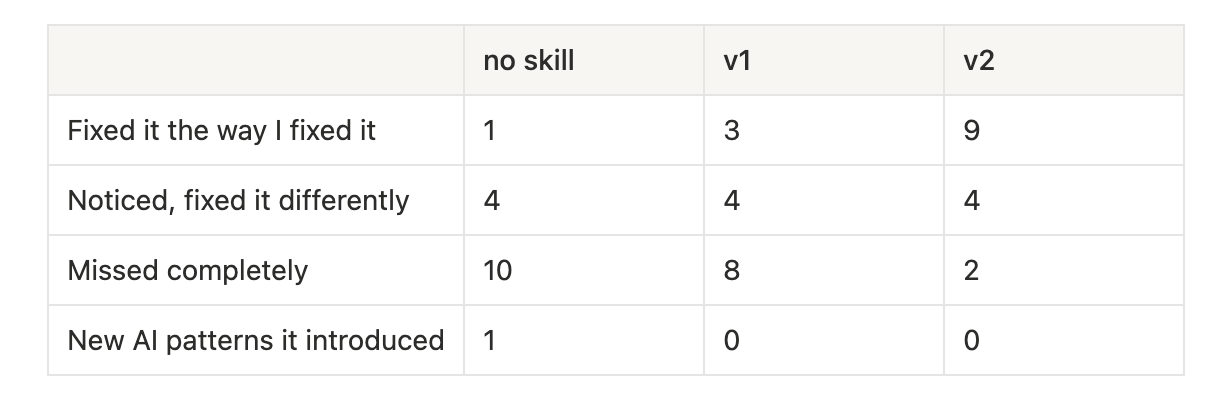
Look at the no skill column. Given a real voice sample and a direct instruction, a fresh model fixed 1 of 15 and added one of its own.
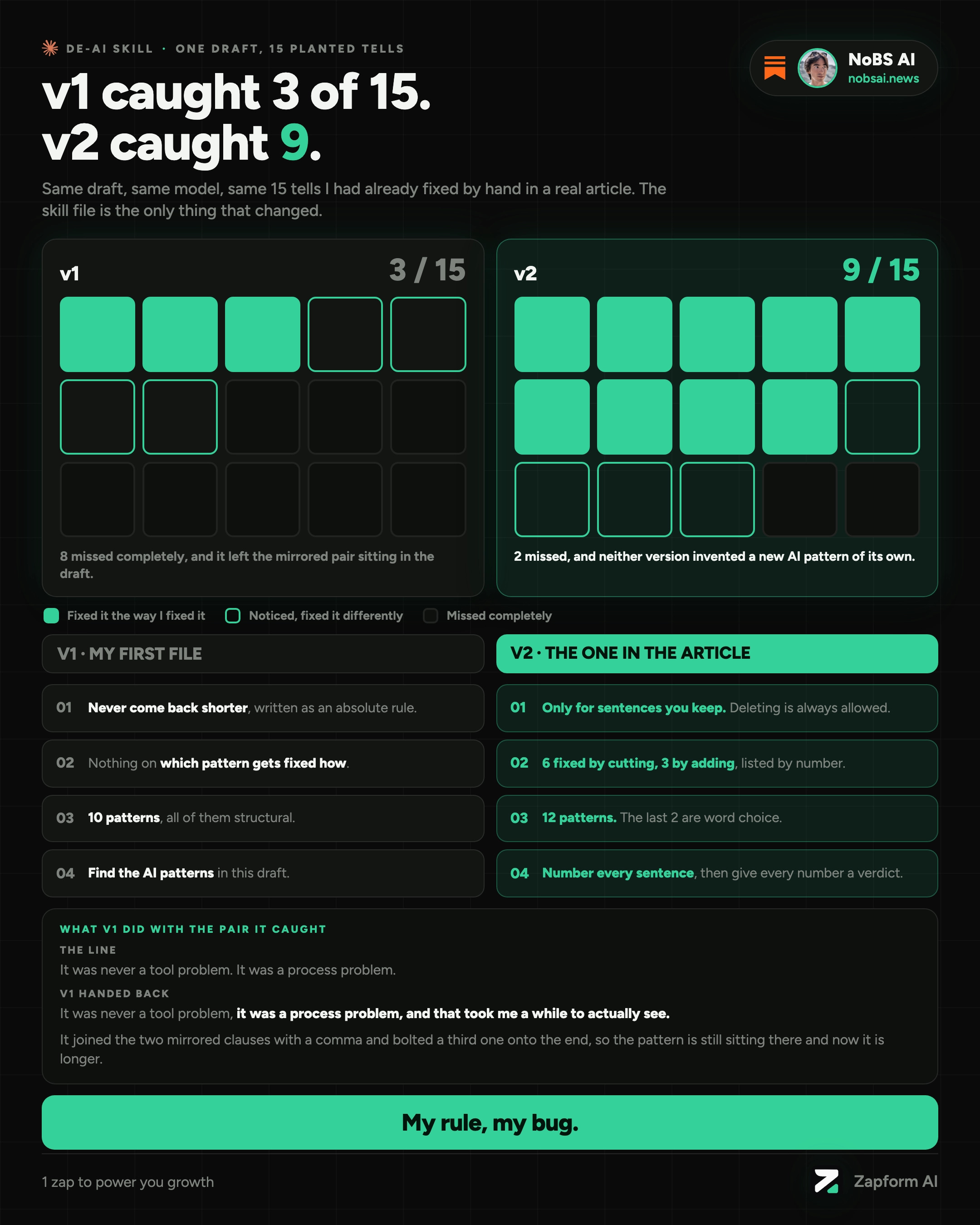
Then v1. It caught the symmetric reversal, quoted it correctly in its own table, and then fixed it like this:
“It was never a tool problem. It was a process problem.” became “It was never a tool problem, it was a process problem, and that took me a while to actually see.”
v1 was still rough, v2 on the other hand solved the v1 issue with:
“It was never a tool problem. It was a process problem.” became “It wasn’t just a tool problem, eventually it turned out to be a process problem, and that took me a while to actually see.”
The file you’re using is better. Look at the results.
In practice
Here’s what I’d do end to end: open Claude Code or the Claude desktop app → paste the prompt below together with this whole article → hand it 3 to 5 old pieces of your own writing → send → done. About 35 minutes, and most of that is you finding the old writing.
## Context
You're given an article about the 12 patterns that make writing read as
AI-written, a voice extraction prompt, and a skill file called de-ai that
removes the patterns.

## Instructions
Your job is to:

- Read the pasted article and pull out the de-ai skill file in full
- Save it as SKILL.md inside a folder called de-ai, and tell me where you put it
- Run the Step 2 voice extraction prompt on the old writing I give you next,
  and save what it produces as my-voice.md in that same de-ai folder
- Then run the skill on the draft I give you after that, starting from Step 0

## Pasted Article
[Paste article here]
If it breaks, or the first run comes back reading not the way you expect, message me on LinkedIn or here on Substack and I’ll go through it with you.
Talk soon,
Ilya
If you want a more thorough build that gets you at 90%+ of your voice, click here: Soundcheck.