



Intro
Every company or founder or creator nowadays wants leads, and what they usually do is the same old, boring cold email marketing campaign.
They pitch in the first outreach message, they do not care about the actual prospect, they expect to build instant trust, while it’s practically impossible.
Imagine a stranger stops you on the street and asks you for money for something you never wanted to begin with. Your guard goes up, you say “dude, stop pitching me”, and you instantly stop trusting them.
The same thing happens when people are just blasting their prospects with slap pitches via email or DMs. I get that kind of messages every week and I always facepalm myself.

Congratulations! You just lost the prospect’s trust in 0.5 seconds.
Everyone screams that cold email doesn’t work in 2026, not because the approach is bad, but because everyone is doing it in an obsolete and dumb way.
Cold outreach is great of course and it’s really helpful if you’re just starting out, but you know what’s better than cold outreach? Warm outreach.
You know why? Because warm leads don’t have to be convinced to trust you, they’re already interested in what you post or create out there.
This whole article is about how to fix your lead’s trust and get more sales eventually.
Subscribe to No BS AI. One real copy-pasteable build like this every week.
Who can be considered as a warm lead? Your LinkedIn connection who you chatted with here and there, your X (Twitter) follower, your subscriber who gave their email to read your wonderful content, your friends, previous clients. Each and everyone who’s got any interest of interaction with you in the past.
So picture this: someone on LinkedIn or X (Twitter) or Substack liked your post, they maybe even commented, you might be sitting on a gold mine of opportunities and you’re not using any of them. Yes, that really happened to me on this post after I built a banger tweet for a LinkedIn AI tool back in the days:
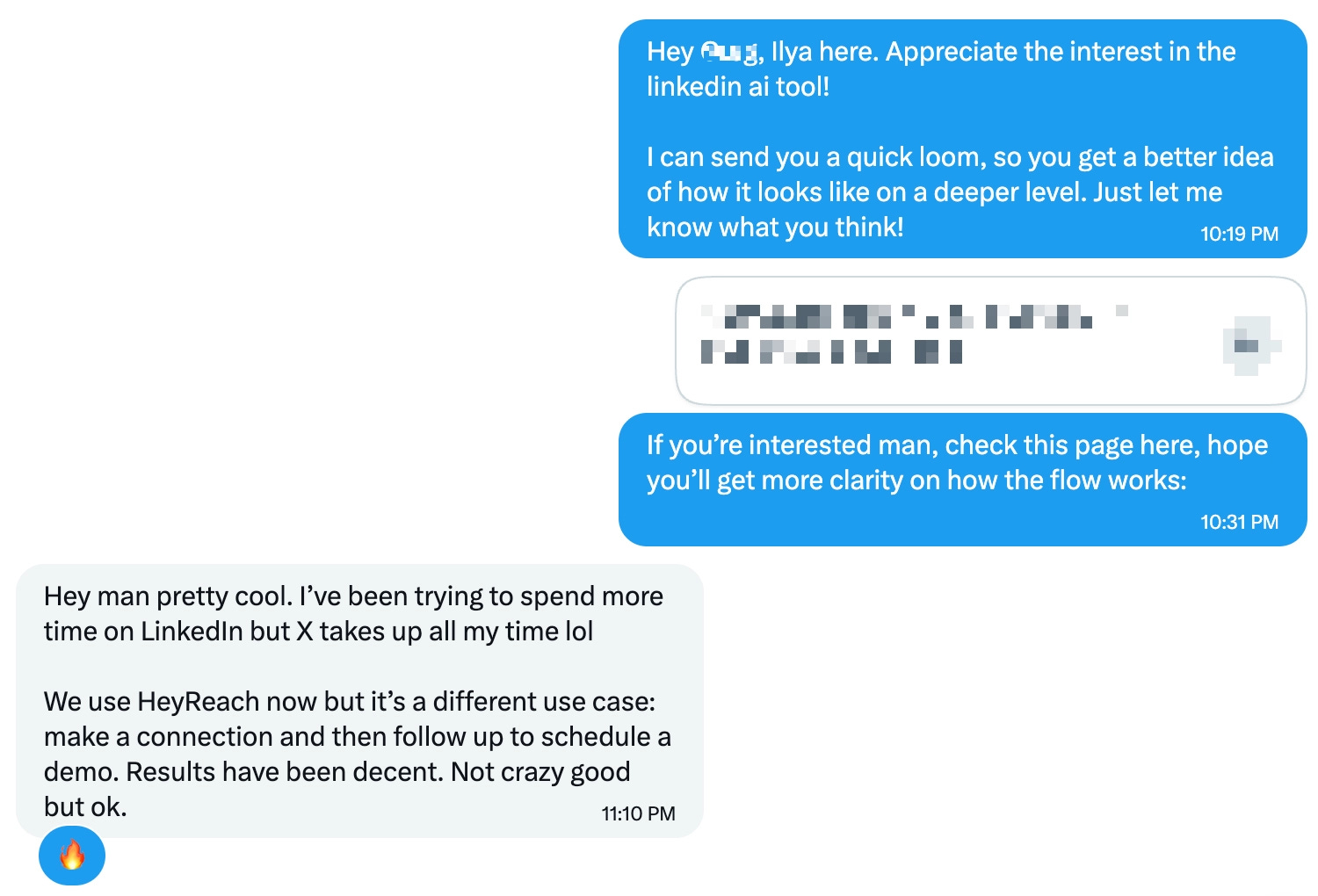
That was one of my first ever clients that I eventually signed for a $2k deal.
This approach takes some time, you cannot just leave it there and have it cook leads for you. Or can you?
What I’m about to walk you through is the manual version: how to find the people who already engaged with your posts, what to write them, and how that turns into a booked call. It’s about 15 minutes a day and you need nothing except your own account.
Every step of it can be automated though, and mine is. The whole loop runs while you’re downstairs taking a coffee, and you come back to a list of warm conversations waiting for your yes.
That’s how a comment under one of my posts became a $2k deal on a new 2 weeks project.
Let’s do the manual version first, I’ll come back to the automated one at the end.
4 Step Process
You need to algorithmically repeat 4 steps: pull the engagement, start a conversation, work out who is actually a fit, book the call.
I run this mainly on LinkedIn and Substack now. Yes, platforms are different but the high level strategy stays the same.
One thing before we start though. This only works if you post something worth engaging with in the first place. If nobody reacted to anything you published this week, there is no list to pull, and no clever messaging fixes that.
Step 1. Pull the engagement
I ask Claude to open my own posts from the last 7 days in the browser and read who reacted and who commented.
It runs in the browser on my own logged-in session, because I got restricted once for cookie-based tooling and I’m not doing that again.
Then it sorts the names into three buckets:
Commented something real and meaningful. Contact.
One-word comment, or reacted to two or more different posts. Something like a “keep it up”, “cheering for you” is not really a signal of interested lead. Contact but don’t expect anything crazy.
Single like on a single post. Contact, but maybe they were just randomly passing by.
A comment beats a like every time because the person showed a deeper interest rather than just liking and scrolling by. Typing a sentence under your post costs more than tapping a button, so it carries more signal.
Expect a small list and that’s better, we’re not aiming for thousands but for a super specific subset of people.
Last thing before you write anything: drop anyone you already messaged in the last 3 weeks. One account writing to the same human twice in two days about two different things reads as a robot.
Step 2. The first message
The whole first message should be thanking the reader first and asking a question. That’s how I usually go about it.
The shape:
hey {first}, saw you commented on the {topic} post, thanks for that.

{one real question about their situation with that thing}
Two blocks, usually under 30 words. Two real ones:
hey Marco, saw you commented on the org chart post, thanks for that.

curious, are you running anything like that yourself or still doing it by hand?
hey John, saw you liked the lead finder post, appreciate it.
what are you using for lists at the moment?4 rules I keep:
Mention the actual post you’re referring, a brief description will do. For example “saw you engaged with my content” → bad.
The question has to be answerable in one line. “what are you using for that at the moment?” gets a reply. “what’s your whole approach to lead gen?” gets silence, because answering it requires some mental brainstorming that people usually are lazy to do.
Say nothing about what they do for a living. “saw you’re doing great things at X” is the tell.
If the person isn’t connected (no follow, no LinkedIn connection) to you yet, send the connection request or follow with no note and stop there. The message goes out on a later run once they accept.
Step 3. Qualify
Not all people will be leads, not all leads will be clients.
The reply is usually a super good filter. Someone who answers the question is in a conversation. Someone who never replies is just someone who liked a post.
Then I read what they actually said. If they describe a mess I know how to fix, that’s a real conversation. If they’re happy with their setup, I say something friendly and leave it there.
Your newsletter or your article only enters after they reply, and only by asking:
that’s exactly the thing I wrote up last week actually, want me to send it?Ask first, send after they say yes. If the conversation goes somewhere else entirely, let it go there.
Look, to be clear with you. Most of these people will never buy anything from you. Be genuinely fine with that and the ones who do buy will trust you much faster.
Step 4. Book the call
When somebody describes a problem you actually solve, ask for the call in one line:
sounds like the same mess I sorted for {client}, worth 20 minutes on a call to walk you through how I did it?Then send the calendar link once they say yes.
The $2k project I mentioned at the top went like this: a comment under my post, one question in the DMs, a few messages back and forth, a 20-minute call, a 2 weeks build.
Automated way
Everything above is the manual version, about 15 minutes a day.
Mine runs on its own now. Claude reads the engagement across my last posts, checks who I already spoke to, drafts one message per person in my own voice that I calibrated, and hands me the batch to approve before anything goes out. I read the list, I say go, it sends at human pace with gaps between messages.
If you want the same thing running for your coaching, your creator business or whatever you’re building, DM me here and tell me two things: where you post, and what you sell. I’ll tell you straight if it’s worth automating for you or if you should just do the 15 minutes yourself.
In practice
The whole loop takes about 21 minutes a day.
Pull the list (5 minutes). Open your posts from the last 7 days, read the reactions and the comments, write every name into a doc next to the post they engaged with. Sort them into the three buckets. Claude can read the lists for you in the browser, the sorting still takes your eyes.
Write the messages (15 min). One per person, name the actual post, one question each, no link. 2 to 6 people is a normal batch.
Send (1 min). This literally takes nothing.
Then do it again tomorrow with yesterday’s names removed.
Talk soon,
Ilya